Smart Scan Redesign
Gen Digital·2025
Overview
Smart Scan 2.0 was a redesign of the mobile smart scan experience for Avast and AVG, aimed at improving scan result clarity and increasing conversion to premium tiers. The project shipped across Avast, AVG, and Norton, delivering measurable uplift in direct conversions.
Role
End-to-end product design ownership as the sole designer on the project, covering problem definition, user research, UX/UI design, usability testing, and development support.
Goals and Metrics
The aim was to improve clarity of scan results, reduce user confusion, and increase premium conversions. Success was measured through Revenue Per Install (RPI), conversion rate, and upgrade clicks.
Problem
The previous Smart Scan experience presented all results on a single screen, mixing Core (real security risks) and Advanced (upsell) issues. This caused three key problems:
- Lack of clarity during scan — users didn't understand what the system was doing
- Misleading issue representation — mismatch between issue count and actual problems
- Broken interaction model — users tapped non-interactive elements
Hypothesis
Separating Core and Advanced issues into a structured step-by-step flow would help users understand real risks first, building trust and making them more receptive to the premium upsell in the second step.
Process
- Audited the existing mobile scan experience and identified key usability and conversion problems
- Formed a hypothesis that separating Core and Advanced issues into a step-by-step flow would improve clarity and conversion
- Designed the new version based on the hypothesis, prioritising Core issues first to establish trust before upsell, with progress indicators, clear CTAs, and consistent patterns across Android and iOS
- Validated the design through a guerrilla comparative blind test with 6 participants. 5 of 6 preferred the new version, responding to the clearer separation of real issues and paid features, more transparent progress, and the ability to resolve issues directly
- Ran a second round of unmoderated usability testing with 5 participants covering the full scanning experience
- Synthesised findings, proposed improvement suggestions, and delivered a recommendations deck to the team for future iterations
- Launched as an A/B test
Before and After
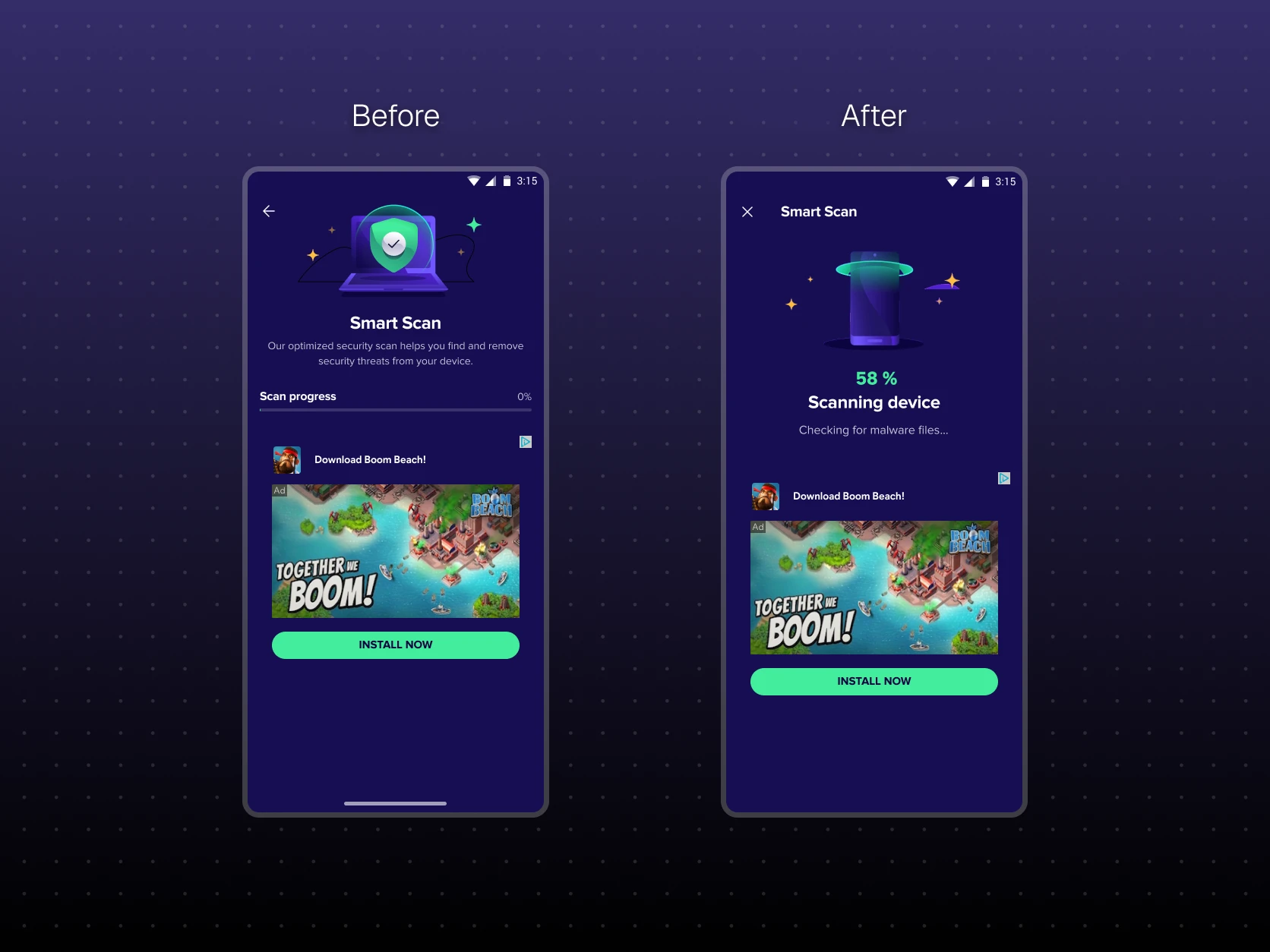
Progress screen
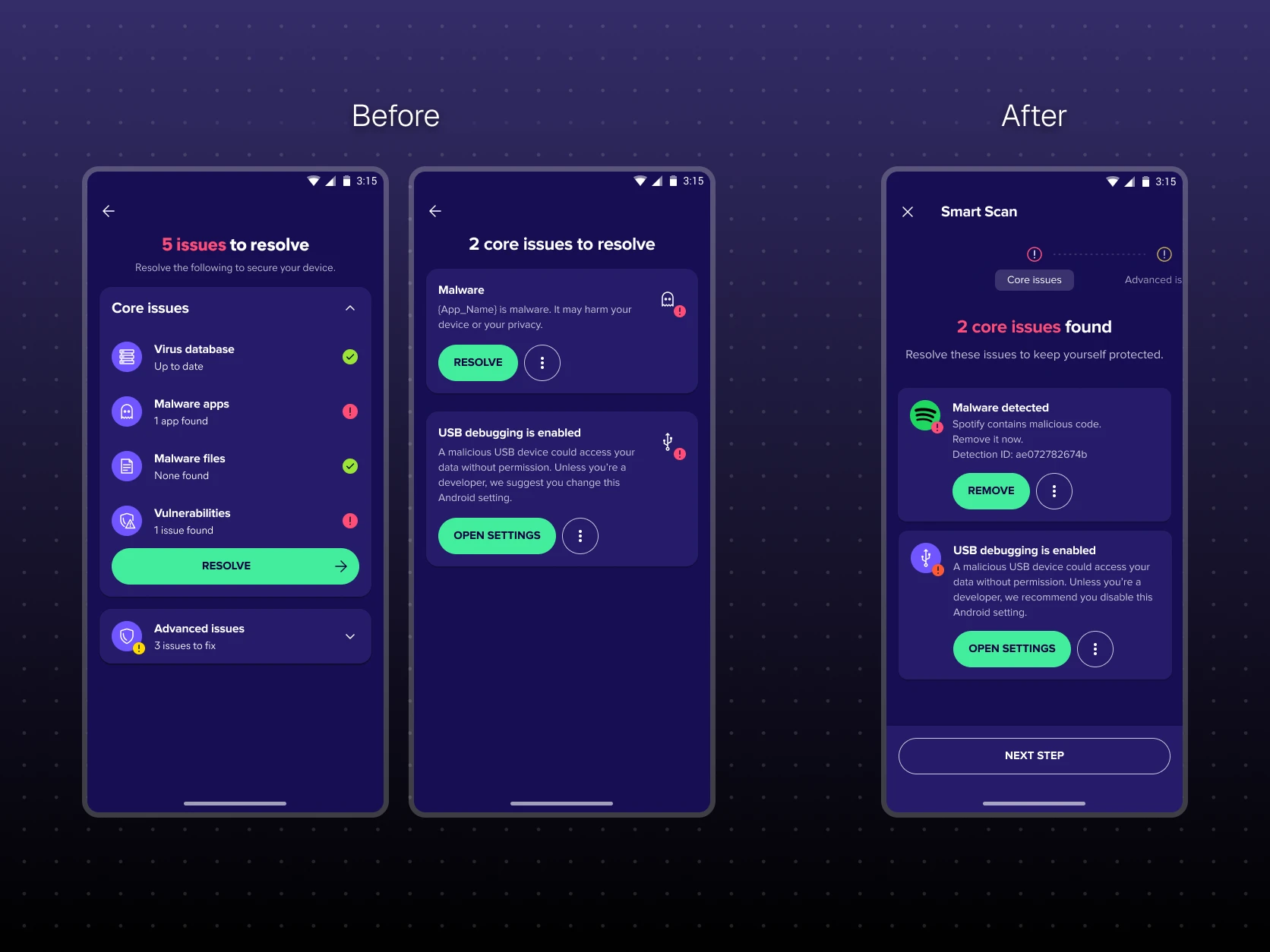
Core issues
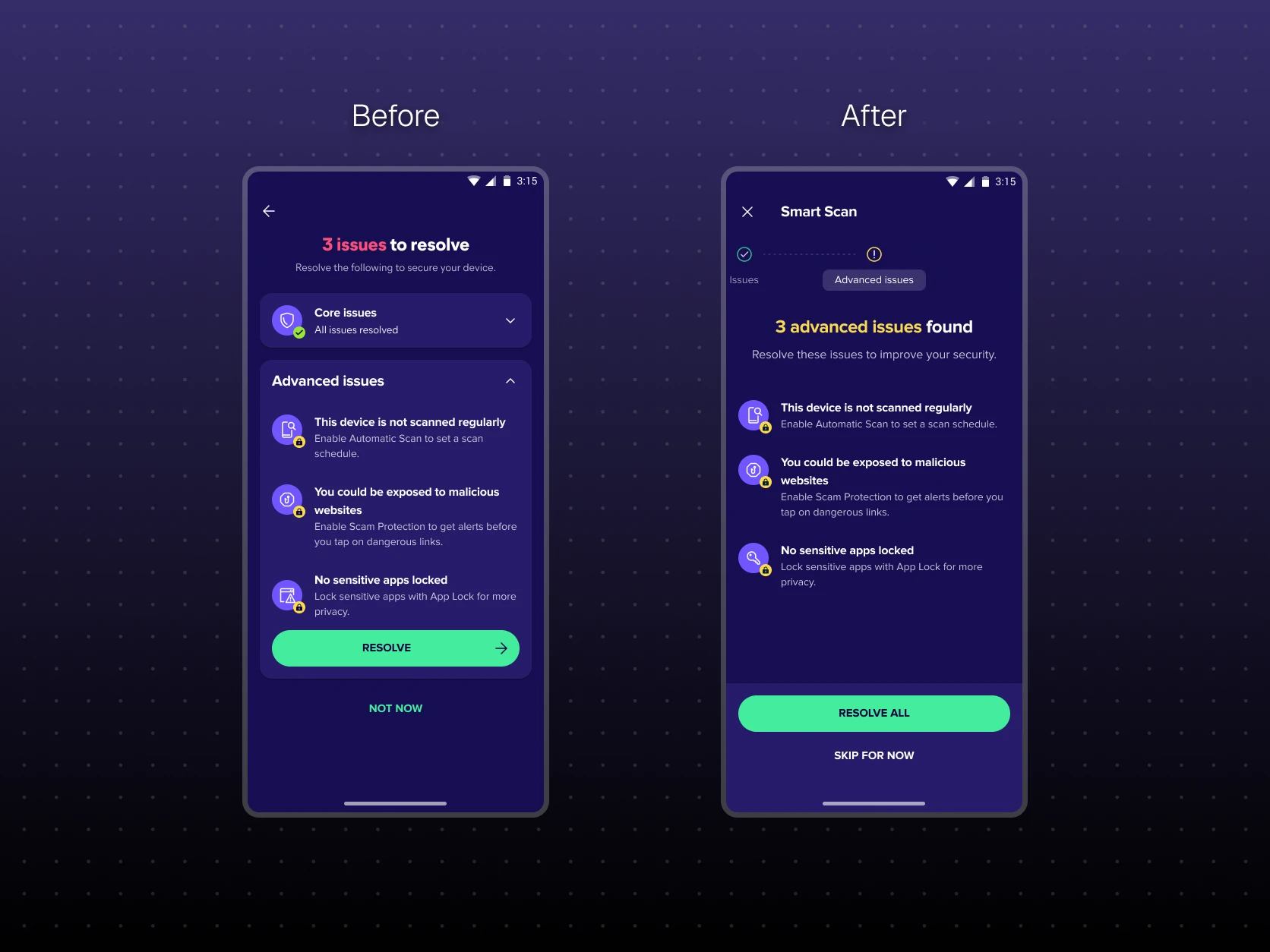
Advanced issues
Outcome
- +3.9% direct conversion uplift
- Six-figure annualized revenue impact
- Rolled out to Avast, AVG, and Norton
- Designed as a white-label, reusable system adaptable across brands and platforms
Scaling to Norton
Smart Scan 2.0 was built as a white-label system from the start. Norton was the first real test of that. Unlike Avast and AVG, Norton had a scan but it never showed a results screen, meaning users had no existing mental model for scan results. This was not a straight port. It required adapting the flow for a new context and a new audience.
What changed
- Risks — carried over directly from Smart Scan 2.0, establishing the core value of the scan
- Recommendations (new step) — a new step placed between Risks and Upgrades, surfacing features included in the user's current subscription that had not been activated yet, designed to drive feature activation before any upsell
- Upgrades (renamed from Advanced Issues) — renamed deliberately to be transparent that this step is about paid features, helping users make an informed decision rather than feeling misled
Impact
- Seven-figure annualized revenue impact
Reflection and Learnings
This project taught me that good enough data beats no data. Without support from a research team, I recruited colleagues from Finance, HR, and other non-technical departments to evaluate my design decisions. Some of them had never seen our mobile product before, which made their feedback even more valuable. They reacted exactly like a real user would, without any of the assumptions my design colleagues and I carried from working on the product daily. It was also genuinely fun for everyone involved.
I also learned to separate what I believed was right from what the constraints allowed. I wanted to redesign the Advanced Issues screen but kept it unchanged for the integrity of the A/B test. Knowing when to hold back is as important as knowing what to change.